Facebook
 X
X
 Pinterest
 Copy Link
For anyone wondering why home prices in Massachusetts continue to trend upward, the answer lies in the state’s unique economic foundational base. MA is home to dense concentrations of high‑growth industries—including biotech and biopharma, fintech and tech startups, higher education, healthcare, and research institutions—many supported by significant public and private grant funding.
With world‑class universities, hospitals, and innovation hubs, Massachusetts consistently not only attracts but retains highly skilled talent, hence keeping long‑term housing demand elevated. Many professionals stay long‑term, keeping housing demand strong year after year. At the same time, limited new construction, strict zoning, and land constraints restrict supply.
According to data from Massachusetts Association of REALTORS® (MAR), the Greater Boston Association of REALTORS® (GBAR), and the National Association of REALTORS® (NAR), Massachusetts continues to face a structural housing supply shortage, while demand remains elevated due to strong job growth across biotech, fintech, higher education, and healthcare—contributing to sustained home price pressure.
At the same time, MAR and GBAR reports continue to highlight limited housing supply, driven by slow new construction, zoning constraints, and homeowners holding onto historically low mortgage rates. This supply‑demand imbalance remains especially pronounced in Greater Boston and surrounding suburbs.
Even the Federal Reserve Bank of Boston (2025 Policy Report) confirmed that housing demand has far outpaced supply in New England, with prices rising ~50% from 2020–2024 due to economic growth and limited construction. The Greater Boston Housing Report Card (2024–2025) showed a long‑term mismatch between housing production and population/job growth, contributing to continued upward price pressure.
Key trends shaping the MA market today:
- Homeowners holding onto historically low mortgage rates, limiting resale inventory – thus Ttight resale inventory as owners stay put
- Continued demand in close‑in suburbs as hybrid work persists
- Strong continued preference for move‑in‑ready and energy‑efficient homes
- Growing need for flexible spaces that support work‑from‑home lifestyles
- Ongoing talent retention tied to MA’s innovation and education economy
Taken together, these fundamentals help explain why Massachusetts home prices have remained resilient—and why market conditions continue to favor well priced, well-located homes. Simply put: a resilient economy, steady talent retention, and constrained housing supply continue to push prices higher across much of Massachusetts.
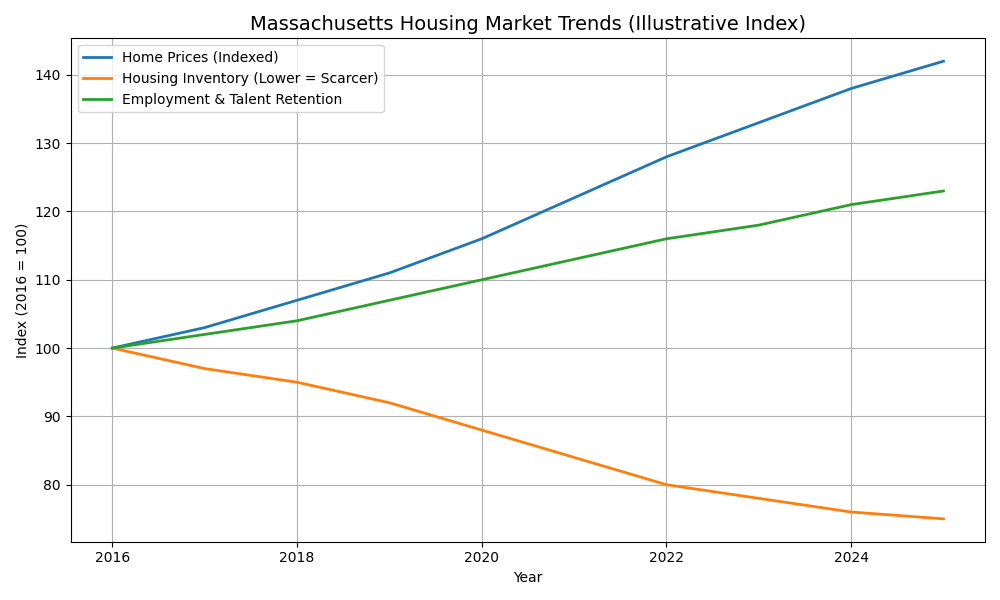
This visual helps explain what MAR and GBAR data continue to show: rising prices are supported by strong employment and talent retention, while housing supply remains constrained.
This is an indexed, illustrative trend chart (2016 = 100) designed to show directional movement, not exact prices.
- Home Prices (Indexed)
Steady upward trend, reflecting long‑term price strength despite rate changes—consistent with MAR & GBAR reporting. - Housing Inventory (Inverse Index)
Downward trend = fewer homes available, highlighting the persistent supply shortage. - Employment & Talent Retention
Gradual upward trend tied to MA’s strong presence in biotech, healthcare, fintech, education, and research.
Sources
🔗 Market data:
Massachusetts Association of REALTORS® – Market Data
🔗 Housing data dashboard & reports:
🔗 NAR data portal:
NAR Housing Statistics & Market Trends