Facebook
 X
X
 Pinterest
 Copy Link
Did You Ever Think About Earning Rental Income From Your Home?
Imagine generating rental income right from your own property—while also adding flexibility, long‑term value, and community impact. That’s exactly what Accessory Dwelling Units (ADUs) make possible. Beyond helping offset maintenance and repair costs, ADUs offer meaningful benefits for homeowners, families, and renters alike.
Why Accessory Dwelling Units (ADUs) Are Gaining Popularity in Massachusetts
Commonly known as ADUs, in‑law units, backyard cottages, or accessory apartments—are becoming one of the most talked‑about housing solutions in Massachusetts. With updated MA ADU zoning laws, favorable by‑right approvals, and growing demand for smaller, flexible housing options, ADUs are reshaping how homeowners think about property use and value.
Benefits of ADUs for Property Owners
For homeowners, ADUs open the door to more than just extra income:
- Rental income potential to help cover mortgage payments, taxes, or upkeep
- A low‑cost housing option for family or loved ones, with the flexibility that occupants do not need to be related to the owner
- Aging‑in‑place solutions, such as housing caregivers onsite or nearby
- Downsizing without leaving your community—live in the ADU and rent the main home, or vice versa
- Increased property value and long‑term adaptability for changing life needs
ADUs allow homeowners to maintain roots in their neighborhood while planning for the future.
Benefits of ADUs for Renters and the Community
From a renter and community perspective, ADUs play an increasingly important role in addressing housing needs:
- Smaller, more attainable rental units ideal for singles, couples, and small households
- Stable, long‑term housing options that allow renters to stay in neighborhoods they already know and love
- Much‑needed affordable and diverse housing inventory
- Accessible housing opportunities for seniors, individuals with disabilities, or medical needs
- More sustainable development, using existing land and infrastructure rather than building new single‑family homes
Because ADUs are typically smaller in size, they use less water and electricity, making them a more economical and environmentally friendly housing option.
A New Opportunity in Massachusetts: ADU Law Update
Now is the perfect time to explore an ADU.
Massachusetts recently passed a more favorable Accessory Dwelling Unit law, making it easier than ever for homeowners to plan and build an accessory home on their property.
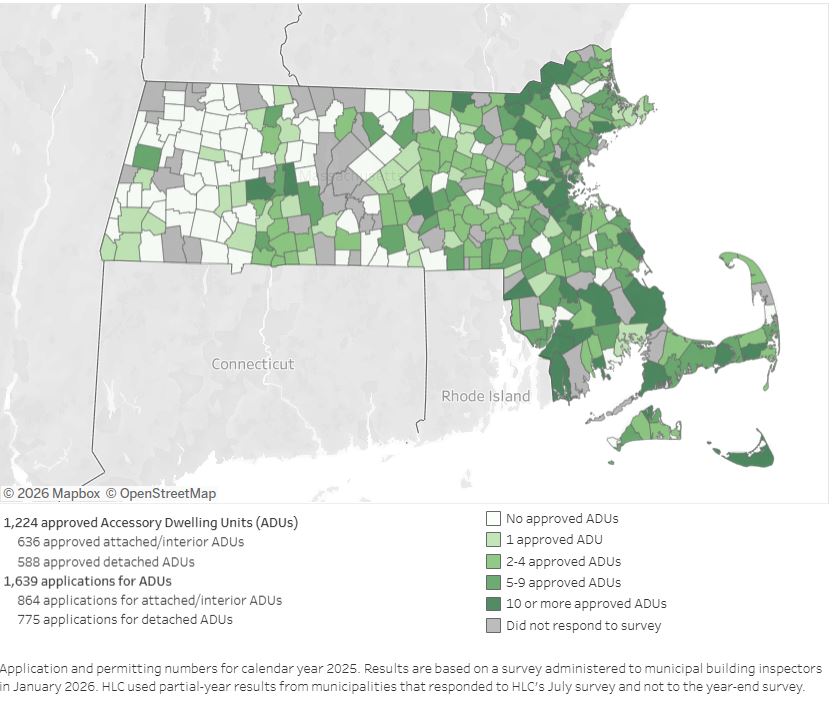
The regulation 760 CMR 71.00: Protected Use Accessory Dwelling Units took effect on January 31, 2025, under the Affordable Homes Act (Sections 7 and 8). It amends M.G.L. Chapter 40A, Sections 1A and 3, allowing ADUs under 900 square feet to be built by right in single‑family zoning districts across the state.
Local Guidance, Design Help, and Financial Support
Organizations such as HLC, in partnership with the Metropolitan Area Planning Council (MAPC) and the Massachusetts Housing Partnership (MHP), have developed Model ADU Zoning to guide cities and towns in updating local bylaws.
In Boston and many surrounding towns, homeowners can now build independent living units—also known as ADUs—on their existing property once the design is approved. These units can be located within the main home (such as basement or attic conversions) or, in some cases, as detached units like a backyard cottage.
The City of Boston Planning Department offers an excellent ADU Guidebook that outlines what’s possible, what to consider during the design process, and how to get started. For qualifying homeowners, financial assistance programs may also be available to help with construction costs.
Helpful Resourcesmass.gov/…units-model-zoning-v12/download
🔗 Learn about ADUs in Boston:
https://www.boston.gov/departments/housing/accessory-dwelling-units-adus-boston
🔗 Boston Planning Department Agent Guidebook:
🔗 Massachusetts ADU Overview:
https://www.mass.gov/info-details/accessory-dwelling-units
🔗 ADU Incentives Program & Notifications:
https://www.mass.gov/forms/adu-incentives-program
🏡 ADU Planning Checklist
Before jumping into design or construction, use this ADU Planning Checklist to stay organized and informed:
✅ 1. Zoning & Legal Review
- ⬜ Confirm your property is in a single‑family zoning district
- ⬜ Review state ADU law (760 CMR 71.00) and local bylaws
- ⬜ Verify ADU size limits (up to 900 sq ft by right)
- ⬜ Understand owner‑occupancy and rental rules (if any)
✅ 2. Property & Design Considerations
- ⬜ Determine ADU type:
- ⬜ Interior (basement, attic, over garage)
- ⬜ Attached addition
- ⬜ Detached / backyard unit
- ⬜ Assess utilities, access, parking, and privacy
- ⬜ Consider universal or accessible design (aging‑in‑place)
✅ 3. Financial Planning
- ⬜ Estimate construction costs
- ⬜ Explore ADU Incentives Program or local funding options
- ⬜ Evaluate potential rental income
- ⬜ Understand impact on property value and taxes
✅ 4. Professional Team
- ⬜ Realtor (to assess value & marketability ✅)
- ⬜ Architect or ADU designer
- ⬜ Contractor experienced with ADUs
- ⬜ Lender or financial advisor (if financing)
✅ 5. Permits & Approvals
- ⬜ Review city or town application requirements
- ⬜ Submit plans for zoning and building approval
- ⬜ Schedule inspections during construction
✅ 6. Long‑Term Strategy
- ⬜ Decide: rental unit, family use, or future downsizing
- ⬜ Plan for property management (if renting)
- ⬜ Understand exit strategy for resale or multigenerational use
So Now … Think About Adding an ADU to Your Property…
Whether you’re looking to generate rental income, create space for family, or future‑proof your home, now is the time to explore your ADU options—and you don’t have to figure it out alone.
As a local Realtor deeply familiar with Massachusetts ADU laws, zoning, and market value, I help homeowners:
- Understand what’s allowed on their specific property
- Evaluate resale value and rent potential
- Connect with trusted local professionals (designers, lenders, inspectors)
- Make smart decisions that align with both lifestyle and investment goals
👉 Let’s talk about whether an ADU makes sense for your home.
Visit www.GoToZuby.com or reach out directly to start the conversation.
Your home may already hold more opportunity than you realize.